TMR vs Hall Effect is becoming one of the most repeated specifications in modern gaming-controller marketing. Both technologies use magnetic sensing rather than the traditional contact-based potentiometer approach, but that does not mean every TMR controller is automatically better than every Hall Effect controller.
The practical buying decision still depends on the complete implementation: stick mechanics, calibration, firmware, dead-zone controls, polling behavior, ergonomics, buttons, triggers, platform compatibility and price. This guide explains what the two sensor technologies change and, just as importantly, what they do not.
TMR vs Hall Effect: quick answer
- Both are magnetic sensing technologies. Neither relies on the same sliding electrical contact used by a conventional potentiometer stick.
- TMR can offer higher magnetic sensitivity and lower power requirements at the sensor level. That does not guarantee a better-feeling controller by itself.
- Hall Effect is already mature and widely used in gaming controllers. A well-tuned Hall controller can be an excellent choice.
- Do not treat “TMR” or “Hall Effect” as proof that a controller can never develop drift. Mechanical centering, springs, calibration, firmware and physical damage can still affect stick behavior.
- Buy the whole controller, not only the sensor. Connectivity, extra buttons, trigger design and software frequently matter more in daily use.
What is a Hall Effect joystick?
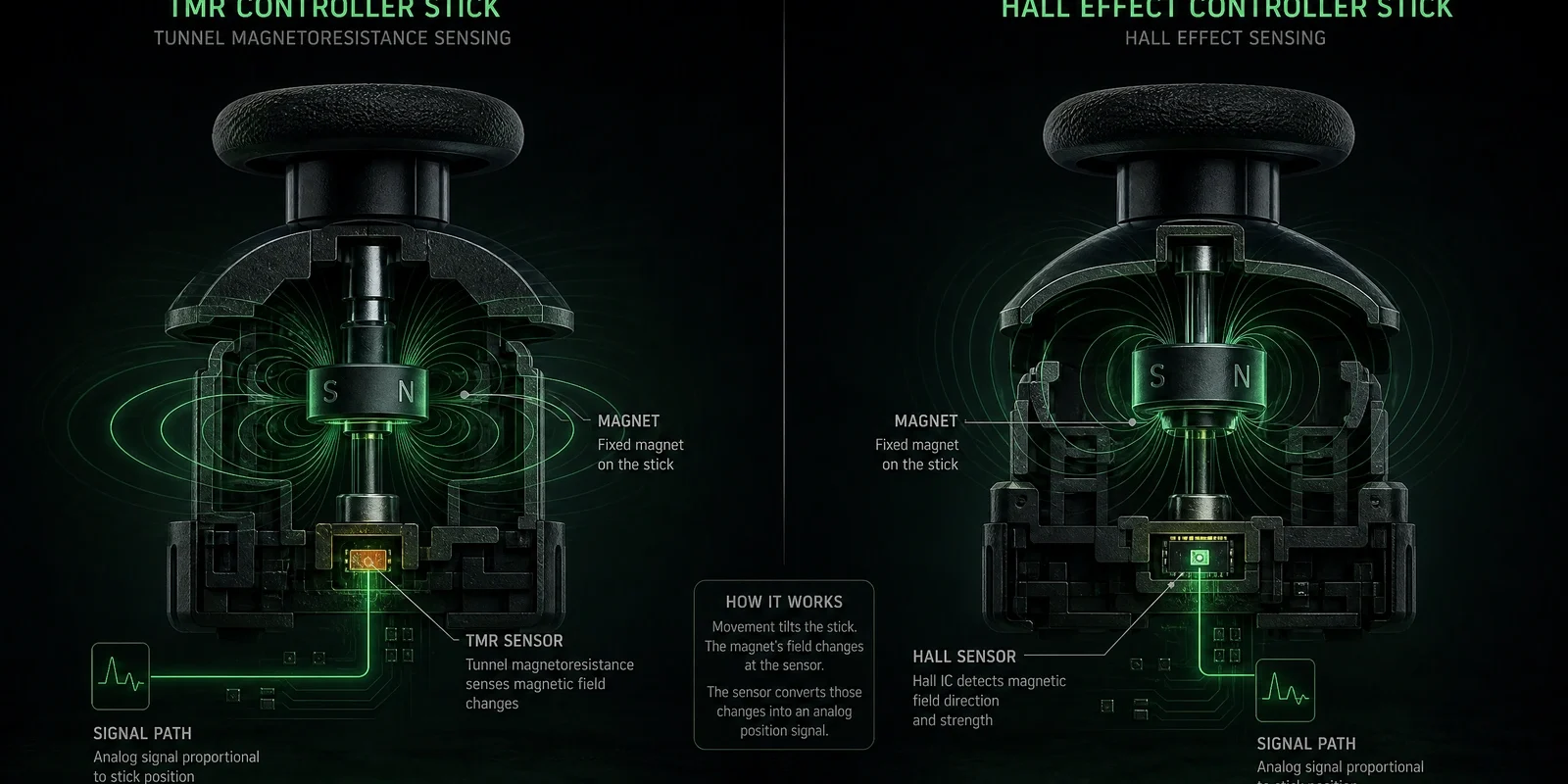
A Hall Effect sensor measures a magnetic field and converts that information into an electrical signal. In a controller joystick, the stick assembly moves a magnet relative to the sensor, allowing the controller to determine stick position without using the same resistive wiper contact found in traditional potentiometer mechanisms.
That contactless sensing approach is one reason Hall Effect sticks have become popular in controllers marketed around durability and reduced drift risk. The sensor itself avoids one traditional wear point, although the rest of the joystick remains a mechanical assembly.
What is a TMR joystick?
TMR stands for Tunnel Magnetoresistance. TMR sensors respond to magnetic fields by measuring changes in electrical resistance within a magnetoresistive structure. Sensor manufacturers such as TDK and Infineon highlight high sensitivity, low power consumption and strong linearity as important characteristics of modern TMR sensing.
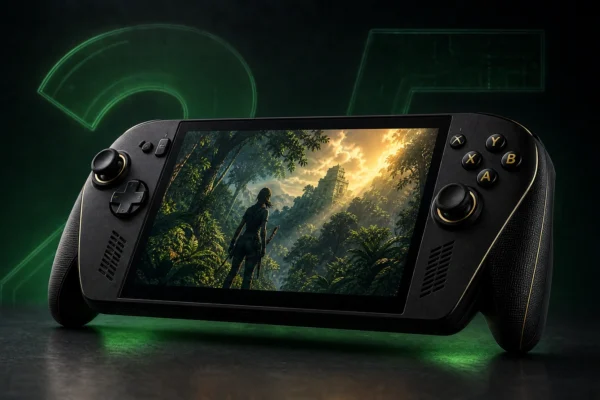
In controllers, manufacturers use that magnetic sensing to track joystick position. GameSir, for example, uses Mag-Res TMR sticks in products such as the G7 Pro, while ASUS uses TMR joysticks in the 2026 ROG Xbox Ally X20 handheld.
TMR vs Hall Effect: the differences that matter
| Area | TMR | Hall Effect | What it means for buyers |
|---|---|---|---|
| Sensing principle | Magnetoresistance changes with magnetic field | Hall voltage changes with magnetic field | Both avoid a conventional potentiometer contact |
| Sensor sensitivity | Can be very high | Strong and mature for position sensing | Implementation still determines usable stick behavior |
| Power consumption | Can be lower at sensor level | Varies by implementation | Potentially relevant to wireless devices, but controller battery life depends on the whole system |
| Gaming-controller availability | Growing quickly in newer models | Already widespread | Hall Effect has more mature product choice today |
| Drift resistance | Removes the same potentiometer contact wear point | Removes the same potentiometer contact wear point | Neither makes every possible cause of drift impossible |
Why “anti-drift” does not mean “nothing can ever drift”
Marketing often compresses a complicated mechanism into one phrase. Magnetic stick sensing can remove an important contact-wear mechanism, but a joystick still contains moving parts. Springs can change, centering can shift, manufacturing tolerances differ, debris or impact can affect motion, and firmware calibration can alter what the console sees as center.
For that reason, we prefer wording such as reduced risk from potentiometer wear rather than guaranteeing that a controller is permanently drift-proof.
Precision: does TMR automatically win?
TMR technology can provide excellent sensitivity and signal quality, but a finished controller must still convert that raw sensor information into useful stick behavior. Resolution, filtering, dead-zone settings, circularity correction, firmware and mechanical centering all affect the final result.
A poorly tuned TMR controller can therefore feel worse than a well-tuned Hall Effect controller. Likewise, two controllers using the same sensor family can behave differently because of firmware or mechanics.
Power consumption: more relevant to handhelds and wireless controllers
Sensor manufacturers identify low power consumption as one potential advantage of TMR technology. That can be useful in battery-powered products such as wireless controllers and handheld gaming PCs.
But buyers should not translate “lower-power sensor” directly into a specific number of extra gaming hours. Wireless radios, lighting, rumble motors, processor behavior, battery size and firmware can dominate total device consumption.
Real controller examples
GameSir G7 Pro: TMR sticks
The GameSir G7 Pro uses the company’s Mag-Res TMR sticks. It is a useful example of how TMR is appearing in value-oriented controllers rather than only expensive flagships. However, the standard G7 Pro is wired on Xbox, which can matter far more than its stick sensor if you require wireless console play.
Razer Wolverine V3 Pro: Hall Effect sticks
Razer’s Wolverine V3 Pro uses Hall Effect precision thumbsticks and targets premium competitive Xbox play with wireless connectivity, extra back paddles and additional remappable inputs.
Our GameSir G7 Pro vs Razer Wolverine V3 Pro comparison shows why the sensor technology is only one part of the purchasing decision.
ROG Xbox Ally X20: TMR sticks and Hall Effect triggers
ASUS combines TMR joysticks with Hall Effect analog triggers in the ROG Xbox Ally X20. That is a useful reminder that manufacturers can select different magnetic technologies for different controls within the same device.
What matters more than TMR vs Hall Effect?
- Platform connectivity: wired versus wireless Xbox support can completely change whether a controller fits your setup.
- Calibration and dead-zone options: good software can make a capable sensor much more useful.
- Stick mechanics: centering force, friction and physical consistency affect feel every time you play.
- Extra controls: rear buttons, paddles, trigger stops and D-pad quality can matter more for competitive play.
- Ergonomics: a technically impressive controller is still a poor purchase if the shape does not suit your hands.
- Warranty and support: advanced sensors do not eliminate the possibility of other hardware failures.
- Price: paying a large premium solely for a sensor label rarely makes sense.
Which should you buy?
Choose the better controller, not automatically the TMR controller. If two otherwise comparable products are similarly priced and the TMR implementation is well reviewed and properly calibrated, TMR can be an attractive newer option. But a proven Hall Effect controller with better wireless support, ergonomics or competitive controls can easily be the smarter purchase.
For actual product choices, see our best Xbox controllers for competitive play and best Xbox accessories.
Frequently asked questions
Is TMR better than Hall Effect for Xbox controllers?
Not automatically. TMR can offer strong sensor-level sensitivity and efficiency, while Hall Effect is mature and widely used. Controller design, calibration, firmware, connectivity and ergonomics can outweigh the sensor difference.
Can TMR controllers still drift?
Magnetic sensing removes a traditional potentiometer contact-wear mechanism, but a controller still contains mechanical parts and calibration software. We therefore avoid promising that any controller is permanently immune to every possible form of drift.
Do Hall Effect sticks use magnets?
Yes. Hall Effect position sensing measures changes in a magnetic field and converts them into an electrical signal used to determine stick position.
Final verdict
TMR is an important controller technology, but it should not become a shortcut for judging overall controller quality. Both TMR and Hall Effect can support excellent magnetic stick designs. The better purchase is the controller that combines reliable sensing with strong mechanics, useful calibration, the right connectivity and a price that makes sense.